
In modern bakery manufacturing, maintaining consistent product quality is essential for consumer satisfaction and brand reliability. For bread texture analysis, one of the most important aspects of bread quality control is texture evaluation, which directly reflects freshness, processing conditions, and ingredient formulation.
Unlike visual inspection, texture cannot be reliably judged by appearance alone. Therefore, objective measurement using a analizator tekstury żywności and standardized texture analysis methods has become a core part of industrial bakery quality systems.
Key Texture Indicators in Bread Texture Analysis
Bread quality is determined by multiple physical properties that define eating experience and structural stability. These indicators are commonly used in laboratory testing and production monitoring:
Hardness and softness
Hardness reflects the force required to compress bread. Fresh bread typically shows lower hardness, while staling leads to increased resistance due to starch retrogradation.
Elasticity and springback behavior
Elasticity measures how quickly bread returns to its original shape after deformation. Good elasticity indicates a stable gluten network and proper fermentation control.
Cohesiveness of crumb structure
Cohesiveness describes internal bonding strength. It influences whether bread crumbles or remains intact during slicing and chewing.
Moisture retention capacity
Moisture content affects softness and shelf stability. Poor moisture retention leads to dry texture and reduced consumer acceptance.
Crumb uniformity
Even air cell distribution ensures consistent texture and improves mouthfeel perception.
These parameters together form the foundation of bread quality control in both R&D and production environments.
Bakery Products Analyser in Industrial Bread Evaluation
A bakery products analyser is widely used to convert subjective texture perception into measurable data. It provides repeatable mechanical testing conditions that simulate biting and chewing behavior.
In production environments, it is commonly used for:
- Monitoring batch consistency
- Optimizing baking time and formulation
- Evaluating ingredient changes
- Reducing product variability
This approach improves process stability and ensures consistent bread quality control across large-scale production.
Texture Analysis Methods for Bread Structure Evaluation
Different texture analysis methods are used depending on the property being studied. The most common method is compression testing, where a probe compresses bread to simulate mastication.
Other important methods include:
- Penetration testing for crust strength evaluation
- Relaxation testing for internal structure stability
- Repeated compression for chew simulation
These methods provide quantitative insights into mechanical behavior, making bread quality control more scientific and repeatable.
Texture Profile Analysis for Comprehensive Evaluation
Texture profile analysis (TPA) is one of the most widely used techniques in bakery testing. It simulates two compression cycles to replicate human chewing behavior.
TPA parameters typically include:
- Hardness
- Springiness
- Cohesiveness
- Chewiness
- Resilience
These values help manufacturers build a complete mechanical profile of bread and correlate it with sensory perception.
Food Texture Analyzer in Bakery Quality Systems
A analizator tekstury żywności is the central instrument used in modern bread quality control laboratories. It allows precise control of force, speed, and deformation distance, ensuring high repeatability.
Applications in bakery testing include:
- Dough development studies
- Final product texture verification
- Shelf-life stability testing
- Ingredient comparison analysis
By using a food texture analyzer, manufacturers can replace subjective sensory evaluation with objective and traceable data.
Cell Instruments TEX-01 / TEX-01Pro for Bread Testing
For professional bread quality control, the Cell Instruments TEX-01 and TEX-01Pro analizatory tekstur provide reliable solutions for bakery texture evaluation.
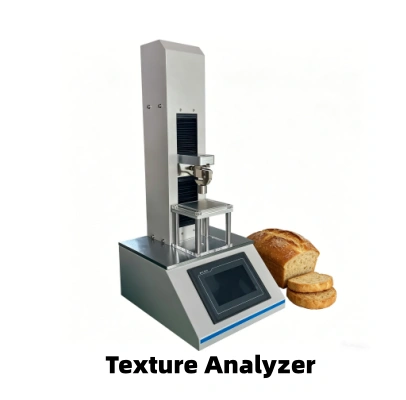
These systems support:
- Compression and TPA testing modes
- Measurement of hardness, elasticity, and cohesiveness
- Stable and repeatable force application
- Flexible test configurations for different bread types
They help standardize texture analysis methods and improve consistency across production lines and R&D environments.
Practical Workflow for Bread Quality Testing
A typical quality control workflow includes:
- Sampling from production batches
- Conditioning under controlled environment
- Texture testing using a food texture analyzer
- Data collection and parameter analysis
- Comparison with internal or industry standards
This workflow ensures objective and repeatable bread quality control results.
Conclusion
Effective bread quality control depends on understanding and measuring key texture indicators such as hardness, elasticity, cohesiveness, and moisture retention. By applying standardized texture analysis methods and texture profile analysis, manufacturers can ensure consistent product quality.
With advanced tools like the bakery products analyser and the Cell Instruments TEX-01/TEX-01Pro food texture analyzer, bakeries can achieve stable production performance and deliver high-quality bread with reliable sensory characteristics.